


Table of Contents
ToggleIntroduction
Water based systems are now commonly used in coatings, inks, adhesives, construction products and surface treatments. They are popular as they have lower VOC levels, they are safer to handle and are easier to meet environmental rules.
However, getting strong adhesion in water based products is not easy. Adhesion means how well a coating, ink or adhesive can stick to a surface. Some surfaces such as metal, plastic, glass and treated materials are difficult to bond with. If adhesion is poor then the film may peel, crack or fail over time.
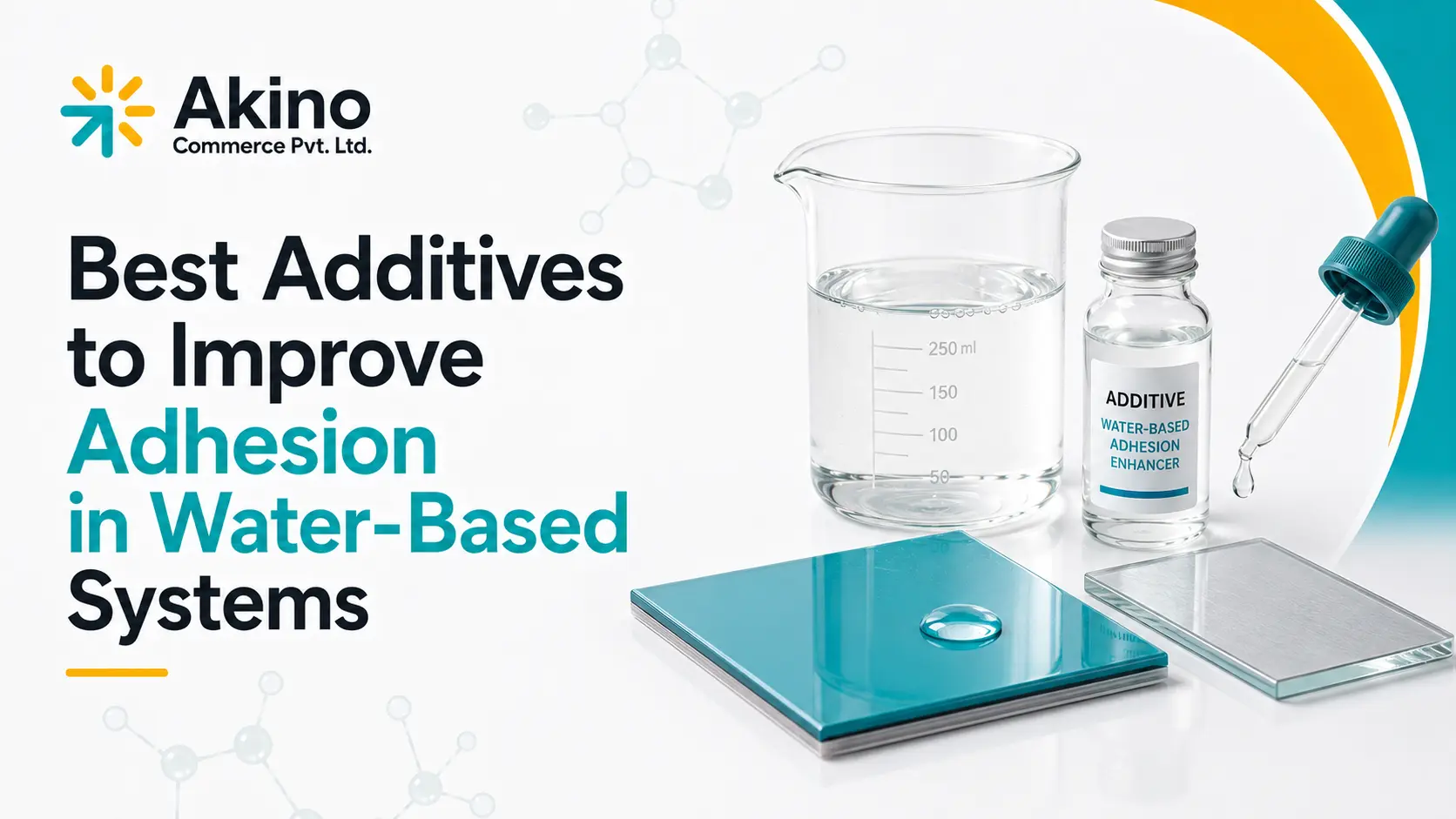
Adhesion improving additives help in solving this problem. They help the product to spread better on the surface, create stronger bonding and also to improve long term durability. These additives are very useful for manufacturers who want water based systems in order to perform well on difficult surfaces.
This blog lists the top 10 best additives for improving adhesion in water based systems and where they are most useful.
Why Adhesion Additives Are Critical in Water-Based Systems
Sometimes, water based formulations can be hard to stick strongly to other surfaces. This happens because of different factors like water has higher surface tension, dries more slowly and is not able to enter some surfaces easily. This is one of the main reasons why the coating, ink or adhesive may not bond properly.
Adhesion additives help to improve this bonding. They allow the formula to spread better, touch the surface properly and also to create a stronger connection between the film and the substrate.
Adhesion additives help in overcoming these limitations by:
- Improving wetting and surface contact
- Creating chemical or physical bonding bridges
- Enhancing film integrity during drying
- Improving resistance to moisture, heat, and mechanical stress
Choosing the right adhesion additive helps water based systems in sticking better, lasting longer and performing reliably while supporting low VOC and eco friendly goals.
10 Best Additives for Improving Adhesion in Water Based Systems
1. Silane Coupling Agents
Silane coupling agents are very effective additives that are used for improving adhesion in water based systems. They help coatings, inks and adhesives to stick strongly to hard surfaces such as metal, glass and minerals.
Key benefits
- Strong chemical bonding to inorganic substrates
- Excellent adhesion to metals, glass, and minerals
- Improves moisture and corrosion resistance
- Works at very low dosage levels
Silanes work like a bridge between the surface and the polymer. One side bonds with the surface and the other side bonds with the coating or adhesive. This creates a stronger and long lasting connection. They are majorly useful in humid, wet or outdoor conditions where better durability and resistance are needed.
2. Polymeric Adhesion Promoters
Polymeric adhesion promoters are special polymer additives that help water based coatings, paints and adhesives in sticking better to different surfaces. They help to improve the connection between the binder and the surface.
Key benefits
- Improved intercoat and substrate adhesion
- Broad compatibility with acrylic and polyurethane systems
- Enhances flexibility and durability
- Low impact on VOC levels
These additives help the coating film in getting attached strongly to the surface. They also improve bonding between coating layers. Polymeric adhesion promoters are commonly used in architectural coatings, industrial water based paints and adhesives where strong and stable adhesion is needed on many types of surfaces.
3. Phosphate Ester Adhesion Promoters
Phosphate ester adhesion promoters are useful additives that are used for improving adhesion on metal surfaces. They help water based coatings and primers to stick better to metals like steel, aluminum and galvanized surfaces.
Key benefits
- Strong interaction with metal surfaces
- Improved corrosion resistance
- Enhanced wetting and anchoring
- Suitable for water-based primers
Phosphate esters work by reacting with the metal surface and forming a stable bonding layer. This helps the coating to hold firmly to the metal and also gives better protection against corrosion. They are commonly used in water based primers, metal coatings and industrial paints where strong adhesion and rust protection are important
4. Acrylic Functional Monomers
Functional acrylic monomers are incorporated into water-based polymer systems to enhance adhesion.
Key benefits
- Improved polar interaction with substrates
- Enhanced film cohesion
- Better adhesion to plastics and metals
- Long-term durability
These monomers add useful groups into the polymer structure. These groups help the film in connecting better with the surface and also make the film stronger from inside. They are commonly used in high performance water based coatings and adhesives where the product needs both strong adhesion as well as good flexibility.
5. Polyurethane Dispersion (PUD) Modifiers
Polyurethane Dispersion modifiers are also known as PUD modifiers They are used to improve adhesion, flexibility and strength in water based systems. They help the coating or adhesive to form a strong and smooth film on the surface.
Key benefits
- Excellent flexibility and toughness
- Strong adhesion to plastics, wood, and metals
- Improved abrasion resistance
- Compatible with eco-friendly systems
In water based adhesives and coatings PUD modifiers help to improve wet adhesion and final bonding strength. They are mainly useful when the product needs to bend, stretch or handle rubbing and mechanical stress without cracking.
6. Wetting and Penetration Agents
Wetting and penetration agents help water based coatings, inks and adhesives in spreading better on the surface. They reduce surface tension which allows the formula to touch the surface more evenly.
Key benefits
- Improved substrate wetting
- Enhanced penetration into porous surfaces
- Reduced defects like craters and fisheyes
- Improved film uniformity
These additives do not directly make the coating stick stronger, but they help the coating spread better on the surface. When the coating spreads evenly and goes into small holes or rough areas, it can hold the surface more firmly. Wetting agents are very useful on surfaces where water based coatings do not spread easily such as plastic, rough surfaces, dirty surfaces or low energy surfaces.
7. Amine-Functional Additives
Amine functional additives are useful materials that help water based coatings and primers in sticking better to surfaces. They also help in controlling the formula’s pH as well as improve stability.
Key benefits
- Improved adhesion to acidic or polar substrates
- Enhanced binder-substrate interaction
- Improved corrosion resistance on metals
- Better stability in water-based systems
These additives are mainly useful in water based metal coatings and primers. They help the coating to connect more strongly with the surface and also to support better rust protection. They also help the coating film stay strong and stable after drying.
8. Carboxylated Latex Polymers
Carboxylated latex polymers are water based polymers that are used to improve adhesion in coatings as well as adhesives. They help the product in sticking better to surfaces such as paper, wood and metal.
Key benefits
- Improved hydrogen bonding with substrates
- Enhanced adhesion to paper, wood, and metals
- Better film strength
- Improved water resistance
These polymers contain carboxyl groups which help the coating or adhesive to connect more strongly with the surface. Simply we can say that, they make the film stronger, stickier and more water resistant. They are commonly used in packaging adhesives, construction coatings and water based industrial finishes.
9. Nano-Silica and Nano-Additives
Nano silica and nano additives are very tiny particles that are used to improve adhesion, strength and durability in water based systems. Because they are extremely small, they can spread well inside the formula and can help in improving the coating film.
Key benefits
- Increased surface contact area
- Improved mechanical anchoring
- Enhanced durability and abrasion resistance
- Minimal impact on formulation viscosity
Nano silica and similar additives help the coating hold better to the surface. They also make the film stronger and more resistant to rubbing, scratching and wear. These additives are commonly used in advanced water based coatings and special functional materials where strong adhesion and long lasting performance are needed.
10. Bio-Based Adhesion Promoters
Bio based adhesion promoters are additives that are made fully or partly from renewable natural sources. They help water based coatings, inks and adhesives to stick better while supporting eco friendly product goals.
Key benefits
- Renewable or partially bio-based
- Low toxicity and VOC contribution
- Good adhesion enhancement
- Suitable for eco-labeled formulations
These additives are becoming more popular in sustainable coatings and adhesives. They help to improve bonding without adding high VOC levels or strong safety concerns. They are especially useful in products made for customers who want safer, cleaner as well as more environmentally friendly options.
For more information, you can check our website page – Akino.in
How to Choose the Right Adhesion Additive
Selecting the correct additive depends on formulation goals and application conditions.
Key selection criteria
- Substrate type (metal, plastic, wood, glass)
- Binder chemistry (acrylic, PU, hybrid)
- End-use exposure (moisture, heat, chemicals)
- Regulatory and sustainability requirements
- Processing and application method
Best practices
- Conduct substrate-specific adhesion testing
- Optimize dosage to avoid negative side effects
- Combine wetting agents with adhesion promoters where needed
- Work with suppliers offering application guidance
Conclusion
Choosing the right additive is very important in order to improve adhesion in water based systems. Water based coatings, inks, adhesives and construction products are safer and lower in VOC, but sometimes it is difficult for them to stick strongly to various surfaces such as metal, plastic, glass, wood, and treated materials.
Adhesion additives help to solve this problem by improving wetting, bonding, film strength and long term durability. Additives such as silane coupling agents, polymeric adhesion promoters, phosphate esters, acrylic functional monomers, PUD modifiers, wetting agents, amine-functional additives, carboxylated latex polymers, nano additives and bio based adhesion promoters all support better performance.
Most of them work best when they are used in the right amount and tested properly. We can say that these additives help water based systems in sticking better, resisting moisture, heat and stress and give reliable results while supporting low VOC and eco friendly formulation goals