
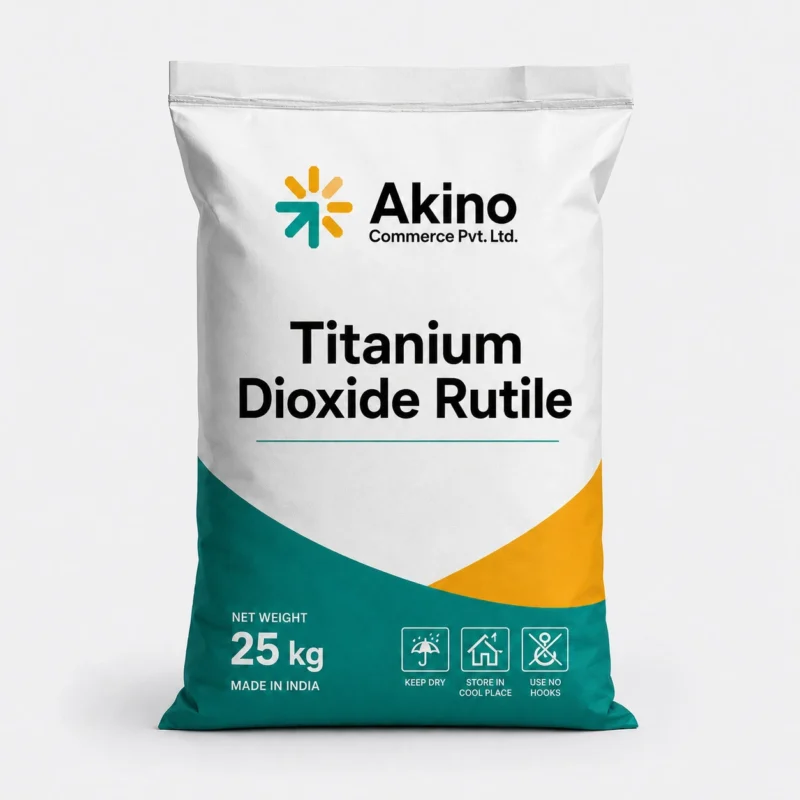

Titanium Dioxide Rutile.

Available Packaging

Every Packing Available

Quality Standard

Origin

Silicone-Based Defoamer

Best Seller

Titanium Dioxide Rutile

High-opacity white pigment for brightness, coverage, and durable finishes

Product Overview

Titanium Dioxide Rutile is a widely used white pigment known for its high brightness, strong opacity, and excellent light-scattering ability. It is suitable for coatings, plastics, and inks where consistent whiteness and coverage are required. Its stable performance and compatibility with different systems make it a preferred choice for achieving high-quality finishes.

Key Features & Benefits

Technical Specifications

Appearance
Fine white powder
Active Content
Titanium dioxide pigment
Recommended Dosage
5.0–25.0% depending on opacity and formulation needs
Shelf Life
24 months in original sealed packaging
pH Range
Stable in standard coating and plastic formulation systems

Industries We Serve

Proven performance across diverse  applications and industries

Specific Applications:

Specific Applications:

Specific Applications:

Specific Applications:

Specific Applications:

Specific Applications:

Usage Guidelines

Addition Stage

Introduce during the dispersion or grinding phase for optimal results.

Dosage Range

Typically used between 0.15–0.6% depending on formulation complexity.

Optimization Note

Pilot trials are recommended to achieve the best balance of dispersion and rheology.

Ready to Experience Superior Control?

Get your free sample of product and see the difference in your formulations. Our technical team is ready to support you every step of the way.

Free Samples

Test before you buy

Technical Docs

Complete TDS & MSDS

Expert Support

Technical consultation

Quick Quote

Instant pricing

🚚 Fast delivery available | 💬 24/7 technical support | ✅ ISO certified quality

Frequently Asked Questions

Common Answers about Your Question
Titanium Dioxide Rutile is used in paints, coatings, plastics, and inks for whiteness, opacity, and brightness.
Rutile offers better opacity, durability, and resistance to weathering, making it suitable for demanding applications.
Yes, it is compatible with both water-based and solvent-based formulations.
It is typically added during dispersion or grinding stages for uniform distribution and maximum performance.
Dispersion quality, particle size distribution, and dosage levels influence opacity and final appearance.

Still Have Questions?

Our technical team is here to help you find the perfect solution

Start typing to see posts you are looking for.